
Retire 10 Years Early: Mastering the FIRE Method
 Did you know that FIRE (Financial Independence Retire Early) practitioners typically save 50-70% of their income to retire decades before their peers?
While the average reported retirement age was 61 in 2022, FIRE followers aim to quit the workforce much earlier. In fact, 43% of young Indians, particularly those aged 25 or below, aspire to retire between the ages of 45 and 55.
To achieve early retirement, you need a solid plan. According to the FIRE method, you’ll need to save up at least 25 times your annual expenses before you can comfortably withdraw 4% each year after retiring. For someone planning to retire at 40 and live until 80, this could mean building a corpus of Rs.16 crore to sustain their lifestyle for 50 years.
The FIRE strategy became popular as part of a movement that encourages people to reduce expenses, increase savings, and invest wisely. Instead of waiting until your 60s to enjoy financial freedom, this approach gives you a concrete framework to potentially retire a decade (or more) earlier.
Ready to learn how you can escape the rat race sooner? This guide will walk you through the practical steps to make your early retirement dreams a reality.
Why Retiring 10 Years Early is Possible
“Financial Independence has nothing to do with rich. It is the experience of having enough — and then some.” — Vicki Robin, Co-author of ‘Your Money or Your Life’, pioneer of the FIRE movement
The myth vs. reality of early retirement
The traditional retirement path is built on outdated assumptions. Most retirement advice assumes you’ll work until your mid-60s, gradually save 15-20% of your income, and then live off Social Security and your savings. This conventional wisdom creates several persistent myths.
One major misconception is that early retirement requires inherited wealth or extraordinary luck. However, successful FIRE practitioners demonstrate that building wealth is actually a repeatable process accessible to anyone with discipline.
Another common myth suggests that pursuing financial independence means living a life of extreme deprivation. Nevertheless, frugality doesn’t equate to unhappiness or sacrifice. FIRE followers often report that cutting unnecessary expenses helps them identify what truly brings value to their lives, leading to more intentional spending choices.
Furthermore, many assume you need to completely stop working at retirement. In reality, modern retirees often shift toward more meaningful pursuits rather than reaching a “hard stop” at 65. The number of workers aged 65 and over has nearly quadrupled since the mid-1980s, not just from financial necessity but from viewing retirement through a more holistic lens.
How FIRE makes it achievable
The FIRE movement’s core premise is remarkably straightforward: calculate your “FIRE number” (generally 25 times your annual expenses), which represents the amount needed to retire comfortably. For example, if you need ₹15 lakh yearly to live, your target would be ₹3.75 crore.
Subsequently, FIRE followers typically withdraw 3% to 4% of their savings annually to cover living expenses in retirement. This approach, derived from the Trinity Study, suggests that withdrawing 4% of your investment portfolio each year provides a high probability of your money lasting through a 30-year retirement.
To reach this goal, successful FIRE practitioners employ several key strategies:
-
Create a substantial gap between income and spending – Saving 50-70% of income through both frugality and income growth
-
Invest aggressively – Usually in low-cost index funds or real estate
-
Develop passive income streams – Through dividends, rental properties, or other sources
Additionally, FIRE isn’t one-size-fits-all. Different approaches exist based on your goals:
-
Lean FIRE: Retiring on minimal expenses (sometimes under ₹17 lakh annually)
-
Fat FIRE: Maintaining a more luxurious lifestyle in retirement
-
Barista FIRE: Working part-time after reaching partial financial independence
Essentially, the FIRE movement works because it combines mathematical principles with lifestyle design. By starting early, you harness compound interest-putting ₹70,000 monthly into an investment fund returning 5% annually starting at age 25 would yield nearly four times more by age 65 than if you had started at age 45.
The journey isn’t about racing to retirement but creating freedom. As Pete Adeney, who retired at 30 and helped popularize the FIRE movement, explains, FIRE means “complete freedom to be the best, most powerful, energetic, happiest and most generous version of You that you can possibly be”.
Start with the End in Mind: Your FIRE Number

Image Source: Accidentally Retired
“There’s a general rule of thumb in the FIRE community that you need roughly 25 times your annual spending to be able to retire.” — Dave (Strong Money Australia), Founder of StrongMoneyAustralia.com, FIRE advocate and educator
How much do you really need?
The most widely accepted method for calculating your FIRE number is the 25x rule, derived from the 4% withdrawal strategy. First, determine your annual expenses, then multiply by 25. For instance, if your lifestyle costs ₹10 lakh yearly, your FIRE number becomes ₹2.5 crore. This formula assumes your investments will generate enough returns to support withdrawing 4% annually while maintaining your principal over time.
Your savings rate dramatically impacts how quickly you can reach financial independence. With a 60% savings rate, you could potentially retire in just 12.4 years. Consequently, focusing on increasing your savings percentage often matters more than chasing higher investment returns when planning for early retirement.
Estimating future expenses and inflation
One common mistake is ignoring inflation when calculating your FIRE number. What costs ₹50,000 monthly today could require ₹1.5 lakh monthly in 20 years with 6-7% inflation. To account for this, you must inflate your current expenses to their future value.
For example, if your current yearly expenses are ₹6 lakh, you’re 22 years old, and plan to retire at 50 with 7% inflation, your future annual expenses would be approximately ₹39.89 lakh. Your FIRE number would then be 25 times this inflated amount.
Healthcare costs specifically deserve attention, as Fidelity estimates they represent approximately 15% of retirement expenses annually. Moreover, for those retiring early, the extended retirement period creates additional challenges, if you retire at 38 and live until 88, that’s fifty years of expenses to fund.
Using a financial independence retire early calculator
FIRE calculators simplify these complex calculations by incorporating variables like:
-
Current savings and investments
-
Monthly expenses
-
Expected investment returns
-
Inflation projections
-
Retirement timeline
These tools help visualize different scenarios and identify potential gaps between your current trajectory and desired timeline. For instance, if you’re 30 years old with ₹20 lakh saved and monthly expenses of ₹50,000, aiming to retire at 45, you might need to save ₹50,000 monthly (assuming 8% returns and 5% inflation) to reach a corpus of ₹6 crore.
Many financial experts now recommend a more conservative 3-3.5% withdrawal rate for early retirees, especially considering longer retirement periods. This adjustment would increase your required FIRE number to 30-33 times your annual expenses.
Ultimately, your FIRE number isn’t static-revisit it at least annually or whenever major life changes occur. As your income, expenses, and investment performance evolve, your target will likely shift accordingly.
Choose Your FIRE Path Wisely
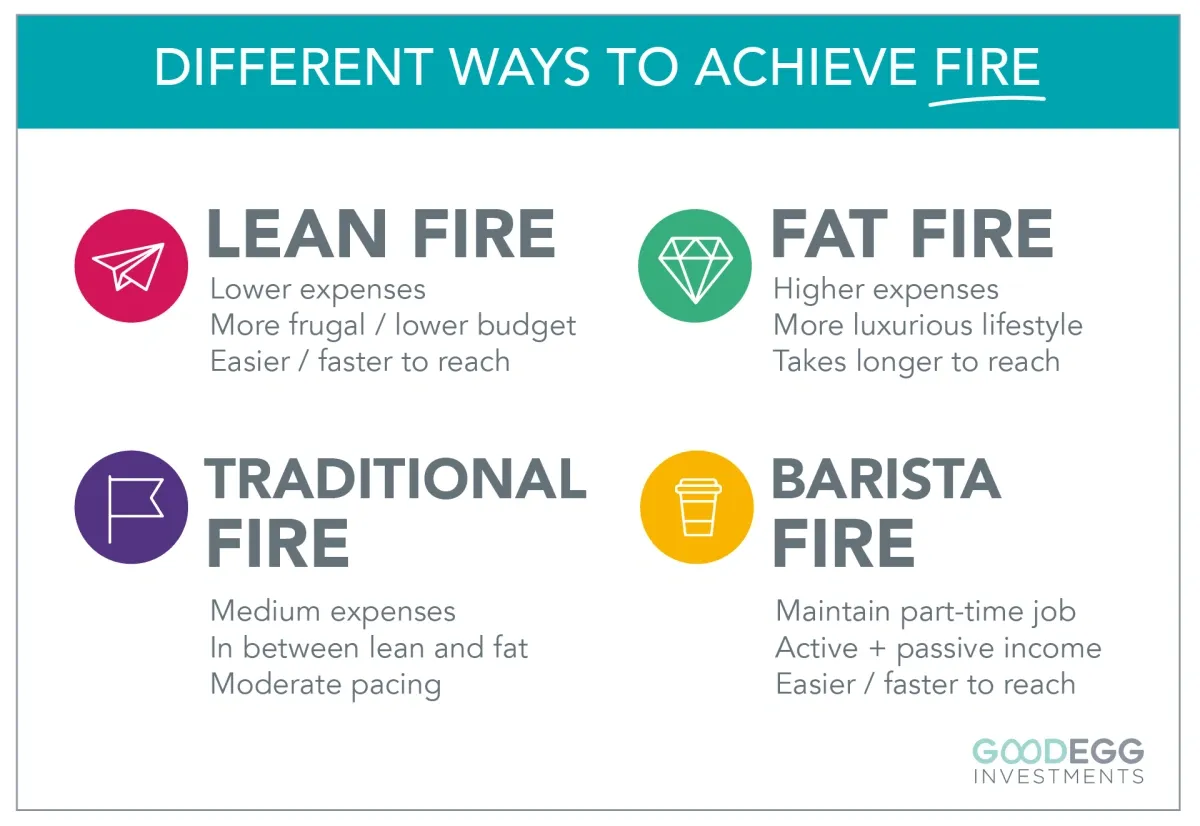
Image Source: Goodegg Investments
Not all financial independence paths look the same. The FIRE movement offers multiple routes to early retirement, each tailored to different lifestyles and goals. Identifying which path suits you best might be the difference between a sustainable early retirement and returning to work prematurely.
Comparing Lean, Fat, and Barista FIRE
Lean FIRE appeals to minimalists committed to frugal living both before and throughout retirement. This approach requires spending as little as possible and living on approximately ₹21 lakh per year or less. The advantage is reaching your retirement goal faster through extreme savings, but you’ll have little flexibility for unexpected expenses or lifestyle upgrades.
Fat FIRE, conversely, targets those who want early retirement without sacrificing their standard of living. This strategy involves earning and saving substantially while maintaining comfortable spending levels. Fat FIRE practitioners typically aim for annual retirement expenses of ₹84 lakh or more. Although this approach provides greater financial cushion, it requires a significantly higher FIRE number-potentially ₹2.8 crore or more-which extends your working years.
Barista FIRE offers a middle path between the two extremes. Instead of complete retirement, you quit your traditional 9-to-5 job but continue working part-time to supplement your savings. This approach, also called Cashflow FI, focuses on generating income streams-ideally passive, to cover living expenses. The name comes from the idea that you might work at a coffee shop or similar low-stress job primarily for benefits like health insurance while keeping retirement funds intact.
How your lifestyle goals shape your FIRE type
Your preferred FIRE path primarily depends on your values and priorities. If freedom from work obligations matters more than material comforts, Lean FIRE might suit you. Alternatively, if maintaining or improving your current lifestyle is non-negotiable, Fat FIRE would be more appropriate despite requiring longer preparation.
Importantly, your long-term responsibilities also influence your choice. If your life goals include financially supporting children or aging parents, FIRE approaches requiring extreme frugality might prove impractical. Similarly, consider how your desired retirement activities align with different FIRE paths, travel enthusiasts might find Lean FIRE too restrictive.
Mental health considerations likewise deserve attention. Some early retirees report feeling purposeless without meaningful work, affecting their psychological well-being. Barista FIRE can address this challenge by maintaining social connections and cognitive challenges while providing financial stability.
Ultimately, the best FIRE path isn’t necessarily the fastest one, but rather the one most compatible with your authentic life vision and personal values.
Build Your Early Retirement Plan
After setting your FIRE number and choosing your path, it’s time to build the financial engine that will power your early retirement journey. This requires disciplined saving, strategic investing, careful planning for healthcare, and eliminating harmful debt.
Creating a high savings rate
The cornerstone of any successful FIRE plan is an aggressive savings approach. Most early retirement achievers save between 50% and 70% of their income. This substantial gap between earning and spending creates the capital needed to reach your FIRE target. First and foremost, embrace frugality without sacrificing quality of life. In addition, channel all bonuses, raises, and investment gains into your savings rather than lifestyle upgrades.
Smart investing for long-term growth
Your investments must work efficiently to build wealth over time. Create a diversified portfolio including:
-
Low-cost index funds and ETFs with minimal expense ratios
-
Dividend-paying stocks for passive income generation
-
Real estate for both appreciation and rental income
High fees can significantly erode your returns over time, so prioritize investment vehicles with low management costs Of course, the power of compound interest becomes your greatest ally, the earlier you start, your investments have more time to grow exponentially.
Planning for healthcare and emergencies
Healthcare represents one of the largest expenses in retirement. A 65-year-old man needs approximately ₹1.4 crore saved just for Medicare and prescription costs. Meanwhile, early retirees must bridge the gap until Medicare eligibility at 65, often through marketplace plans.
Beyond medical expenses, maintain an emergency fund covering 3-6 months of living expenses . This buffer isn’t about returns but accessibility during unexpected situations.
Avoiding high-interest debt
Carrying debt into retirement can undermine your financial security. Certainly, some debt (like low-interest mortgages) might be acceptable, but high-interest obligations must be eliminated before retiring. Credit cards and payday loans are particularly dangerous, with rates that can quickly erode retirement savings . Developing a systematic approach to debt reduction now will ensure greater freedom later.
8 Habits That Make FIRE Work
Success with the FIRE method relies on adopting daily habits that support your financial goals. The following eight practices have proven effective for those who successfully retired 10 years ahead of schedule.
1. Budget every rupee
Creating a detailed budget that categorizes all income sources and expenses forms the foundation of FIRE success. This helps identify areas to save and allocate funds for investments. For simplicity, try the 50-30-20 rule: 50% for needs, 30% for wants, and 20% for savings, though FIRE practitioners often push savings much higher.
2. Save more with every raise
Whenever your income increases, immediately boost your savings rate rather than your spending. Channel all bonuses, increments, and investment gains into savings and investments. This approach maximizes your savings rate, helping you reach your FIRE target faster.
3. Invest consistently
Set up automatic transfers to your savings and investment accounts as soon as you receive your paycheck. Systematic Investment Plans (SIPs) provide a disciplined approach, allowing you to benefit from rupee-cost averaging and the power of compounding.
4. Track your net worth monthly
Net worth, the difference between what you own and what you owe, offers key insights into your financial health. Tracking this metric monthly shows whether you’re moving closer to your goals. Focus on the trend rather than absolute numbers. Are your assets increasing and debts decreasing over time? That’s heading in the right direction.
5. Cut unnecessary subscriptions
Regularly review subscription services that drain your finances. From streaming services to gym memberships, these expenses can add up to hundreds of dollars annually. Try turning off services for a month to see if you truly miss them.
6. Use visual tools to stay motivated
FIRE is a marathon, not a sprint. Visual tools like graphs and progress trackers make your journey tangible. Consider apps that aggregate your accounts and visualize your progress. Some FIRE enthusiasts find it motivating to calculate how each ₹42,190 saved generates ₹84 weekly in passive income at retirement.
7. Avoid lifestyle creep
Lifestyle inflation, increasing your spending as your income rises, is perhaps the biggest threat to achieving FIRE. Without conscious intervention, extra income often leads to expanded wants rather than increased savings. Combat this by maintaining your current lifestyle even as your income grows.
8. Stay flexible with your plan
Financial plans shouldn’t be rigid. Life changes, markets fluctuate, and goals evolve. Review your plan regularly and be willing to adjust your strategy. Some FIRE followers even incorporate “mini-retirements” or shift to part-time work along the way, bringing elements of retirement into their lives earlier.
Conclusion
Financial independence remains achievable regardless of your current age or income level. The FIRE method offers a practical roadmap to retire potentially a decade earlier than your peers through disciplined saving, strategic investing, and mindful spending habits.
Your journey toward early retirement starts with calculating your FIRE number, typically 25 times your annual expenses, and choosing the FIRE path that aligns with your lifestyle goals. Whether Lean FIRE suits your minimalist tendencies, Fat FIRE matches your desire for greater comfort, or Barista FIRE provides the ideal middle ground, each approach offers viable options for escaping the traditional retirement timeline.
Success ultimately depends on maintaining a substantial gap between your income and expenses. Many FIRE achievers save 50-70% of their earnings while developing smart investment strategies focused on low-cost index funds, dividend stocks, and possibly real estate. Additionally, planning for healthcare costs and eliminating high-interest debt beforehand ensures your retirement remains sustainable.
The eight core habits outlined-budgeting deliberately, saving your raises, investing consistently, tracking net worth, cutting unnecessary subscriptions, using visual motivation tools, avoiding lifestyle inflation, and maintaining flexibility, serve as your practical toolkit for this journey. Though challenging at times, these practices create the foundation for lasting financial freedom.
Remember, FIRE represents more than just retiring early. This approach offers complete freedom to design your ideal life without financial constraints. Rather than focusing solely on escaping work, consider how financial independence allows you to pursue meaningful activities, relationships, and personal growth on your own terms.
The path might seem demanding now, but thousands have already proven the FIRE method works. Through consistent application of these principles, you too can build the financial cushion needed to step away from mandatory work years before conventional wisdom suggests possible.
Keep in touch with me mywealthandme@gmail.com
What is FIRE?